- Home
-
Product
Advanced Po.. Powdered Ma.. Powdered Pr.. EPC Solutio..
- Solution
Powder addi.. High pressu.. Solutions o..- R & D
Testing & .. Rotating Di.. Industrial .. Plasma Atom.. Gas atomiza.. Co-develope..- News
- About skyli..
Direct-Combustion Silica and Alumina Production Equipment
(Fillers for GPU Copper-Clad Laminates (CCL)) Technical Principle: Direct combustion uses silicon or aluminum metal powder as solid feedstock, reacting with oxygen and fuel gas in a 1600–2200°C flame to produce spherical submicron SiO₂ or Al₂O₃ powders. This advanced-filler technology ensures consistent powder qualit..
Contact UsProduct introduction
Technical Features
- Designed for Advanced Electronic Materials:
Produces high-performance silica and alumina fillers for GPU copper-clad laminates (CCL), with a focus on low dielectric loss, low thermal expansion, and low radioactivity.
- Automated, Continuous Production:
Integrates feeding, combustion, powder collection, purification, classification, and surface modification to support continuous, highly automated operation.
- Consistent Powder Quality:
Precise process control helps maintain consistent particle size, sphericity, purity, and surface properties across production batches.
- Cost-Effective Manufacturing:
Designed to reduce equipment investment and operating costs compared with imported vapor-phase process equipment.
Product Overview
i. Key Performance Requirements for GPU Copper-Clad Laminates
Advanced GPU substrates and CoWoS packaging substrates require insulating fillers with tightly controlled dielectric properties, thermal expansion, purity, and particle morphology. The equipment is designed to produce spherical powders that address four key requirements.
Low Dielectric Constant and Dissipation Factor (Dk/Df)
Uniform spherical particles with fewer sharp edges and surface defects help support low dielectric loss and high-frequency signal transmission.
Low Coefficient of Thermal Expansion (CTE)
Stable powder properties and high filler loading help reduce thermal deformation, warpage, and cracking in substrate materials during operation under high thermal loads.
Ultra-Low Radioactivity (Low-α)
High-purity feedstocks and controlled impurities support low uranium and thorium content, helping meet the requirements of advanced computing-chip packaging.
High Sphericity and Controlled Particle Size
High powder sphericity improves flowability and resin filling performance. A controlled particle-size distribution supports high filler loading, helping improve substrate thermal performance and structural stability.
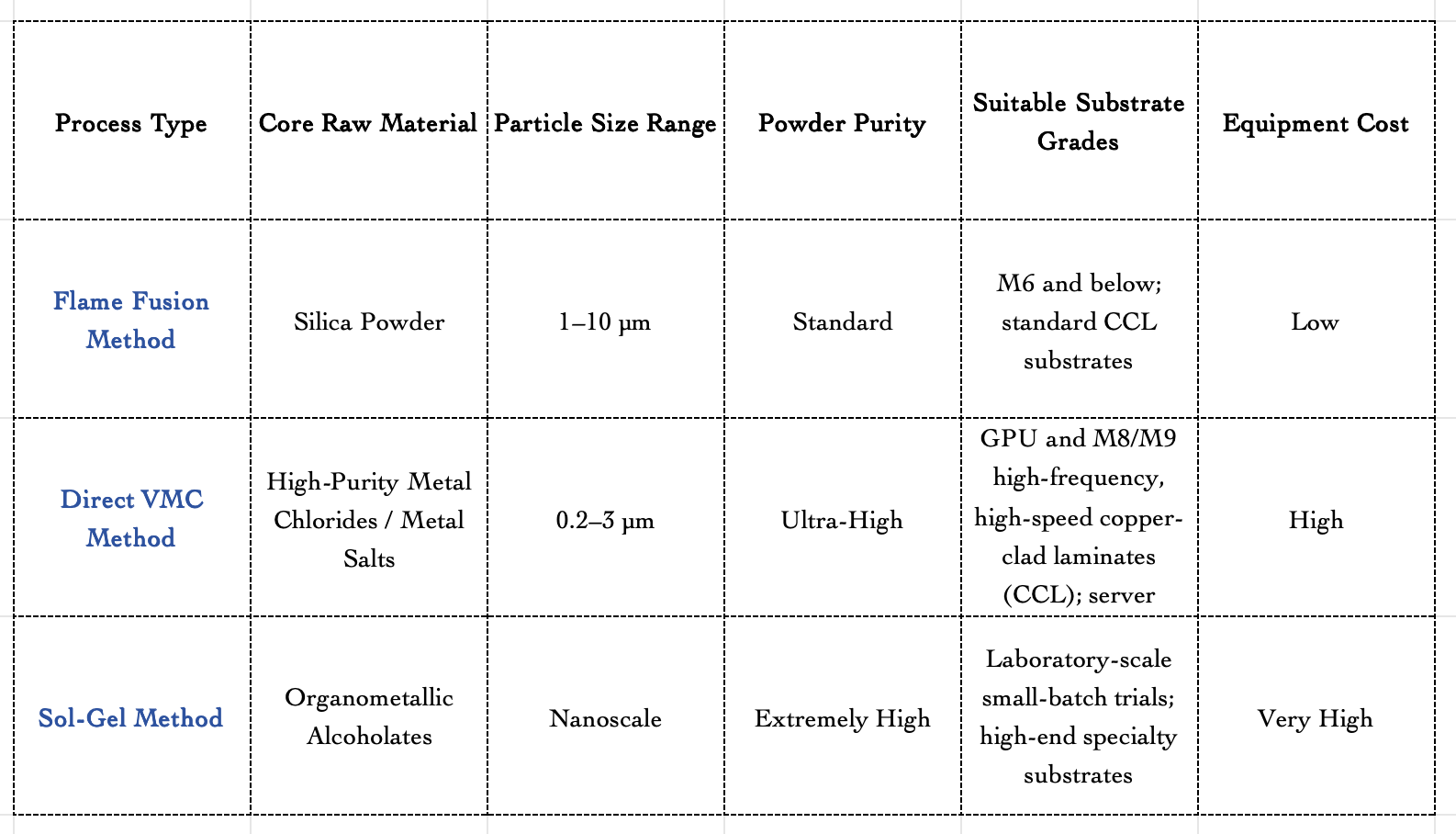
ii. Comparison of Major Powder Production Processes
Core Systems and Functions
System 1: High-Purity Powder Feeding System
The enclosed feeding system delivers silicon or aluminum powder to the burner at a controlled, consistent rate while minimizing exposure to air and moisture.
Key features:
- 316L stainless-steel storage tank with nitrogen sealing, dehumidification, and inert-gas protection.
- Precision twin-screw gravimetric feeder with feeding accuracy of ±0.5% and variable-speed control.
- 99.999% high-purity nitrogen carrier gas, with pressure boosting, drying, and precision filtration.
- Integrated dust pre-filtration and explosion-protection components.
Online oxygen monitoring helps manage the risk of powder oxidation and combustion. When the oxygen concentration exceeds 3%, the system automatically stops and initiates a nitrogen purge.
System 2: Multi-Channel Coaxial Burner
The five-layer coaxial burner controls fuel gas, powder feed, combustion oxygen, temperature-adjustment oxygen, and protective nitrogen through separate channels. This configuration helps maintain stable combustion conditions and consistent powder processing.
Key parameters and features:
- Flame Temperature: 1,700–1,900°C for SiO₂ production; 1,900–2,200°C for Al₂O₃ production.
- Spray Angle: Adjustable from 2.5° to 8°.
- Construction: High-temperature tungsten-copper inner liner with a water-cooled stainless-steel outer structure.
- Safety: Automatic electronic ignition and UV flame monitoring, with automatic shutoff of powder feeding and fuel supply if flame failure is detected.
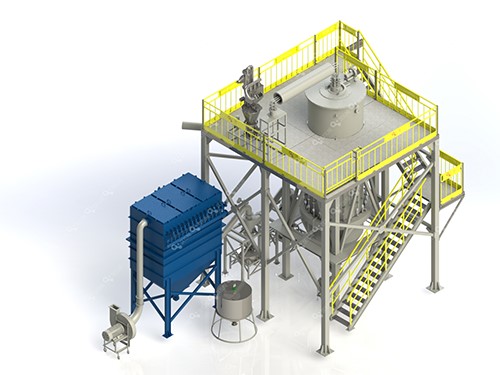
System 3: Vertical High-Temperature Combustion Reactor
The vertical reactor provides the high-temperature reaction zone and controlled cooling conditions required for powder spheroidization.
Its four functional zones support different stages of the process:
- Combustion Zone: Generates the high-temperature environment required for particle melting and spheroidization. A high-purity alumina lining helps minimize contamination.
- Rapid-Cooling Zone: Uses low-temperature nitrogen to rapidly cool and solidify particles, helping reduce particle adhesion and excessive crystal growth.
- Particle Collection Zone: Reduces gas velocity to support downstream powder collection.
- Pressure-Control System: Maintains slight negative pressure to help prevent hot gas and powder from escaping into the production environment.
Main design parameters:
- Reactor inner diameter: 1,200–1,600 mm
- Overall height: 12–18 m
- Height-to-diameter ratio: 10:1
- Particle residence time in the flame zone: 0.2–0.6 s
- Reactor outer-wall temperature: <60°C
An independent cooling-water circulation system helps maintain stable operating conditions.
System 4: Powder Collection and Gas–Solid Separation
A three-stage separation system recovers the finished powder from the reactor exhaust while removing coarse particles and fine dust.
- Primary Agglomerator: Uses low-temperature nitrogen to promote controlled agglomeration of ultrafine particles and improve collection efficiency.
- Cyclone Separator: Collects more than 85% of the finished powder. Coarse particles are returned to the reactor for further processing, reducing material loss.
- PTFE-Coated Bag Filter: Captures ultrafine particles with a filtration precision of up to 0.1 μm. The stated overall powder recovery rate is ≥99.2%.
A nitrogen-sealed hopper and rotary discharge valve help prevent air ingress during powder collection.
System 5: Powder Purification and Thermal Treatment
Freshly produced powder may contain trace metal oxides, surface hydroxyl groups, and alkaline impurities. The purification system helps improve powder quality and prepare the material for high-end electronic applications.
- Continuous Deacidification Rotary Furnace: Operates at 180–300°C under nitrogen to remove surface impurities. Powder pH is controlled within 5.5–7.0.
- High-Temperature Alumina Conditioning Furnace: Operates at 1,200–1,400°C to stabilize the α-Al₂O₃ crystalline structure.
- Online Impurity Monitoring: Monitors elements including Na, K, Fe, and Cu, with total metal impurities controlled to <10 ppm.
System 6: Precision Particle-Size Classification
The classification system adjusts particle size to meet different powder formulation requirements, including blended powders with nominal sizes of 0.3 μm, 1 μm, and 2 μm.
A multistage vortex air classifier with variable-frequency control allows the D50 cut size to be adjusted within the range of 0.2–3 μm. Coarse particles are automatically returned to the reactor for further processing, helping reduce material waste and improve powder utilization.
The stated particle-size span is ≤0.1 μm.
System 7: Online Powder Surface Modification
Surface modification improves the compatibility of spherical powder with resin systems, helping increase filler loading and reduce the risk of processing defects such as delamination and cracking.
The continuous dry-treatment module operates under a low-temperature nitrogen atmosphere. An atomized silane coupling agent is applied at a controlled temperature of 80–150°C, while continuous mixing helps achieve uniform surface coverage.
Two types of modified powder can be produced:
- Hydrophilic SiO₂: For conventional epoxy-resin copper-clad laminate systems.
- Hydrophobic SiO₂/Al₂O₃: For high-end GPU copper-clad laminates using high-frequency hydrocarbon resins, where low water absorption and low dielectric dissipation are important.
System 8: Exhaust Treatment and Energy Recovery
The integrated exhaust-treatment system combines waste-heat recovery, gas recycling, and exhaust purification to reduce energy consumption and support environmental compliance.
A high-temperature exhaust heat exchanger preheats combustion and feed gases, reducing overall equipment energy consumption by more than 30%. An acid–alkali scrubbing tower treats trace metal-oxide fumes and acidic exhaust gases. Nitrogen and residual heat are recycled where applicable to help reduce operating costs.
System 9: Automatic Control and Process Monitoring
The equipment uses centralized PLC control with an HMI touchscreen to monitor key operating parameters in real time, including furnace temperature, gas pressure, oxygen concentration, feed rate, and classification settings.
Key functions include:
- Preset process parameters and automatic adjustment
- Real-time process monitoring
- Fault alarms
- Operating-data recording and traceability
Automated control reduces manual intervention and helps maintain consistent powder properties during continuous production.
Key Performance Parameters
For GPU copper-clad laminate applications
- Powder Sphericity: ≥98%, with no irregular or fractured particles
- Particle Size: Adjustable D50 of 0.2–3 μm; particle-size span ≤0.1 μm
- Impurity Content: Total metal impurities <10 ppm; U + Th <5 ppb (Low-α grade)
- Dielectric Properties: Dk ≤3.0; Df ≤0.003 (tested at 10 GHz)
- Coefficient of Thermal Expansion (CTE): ≤15 ppm/°C
- Powder Moisture Content: ≤0.05%
Applications
The equipment is designed for producing high-performance silica and alumina fillers for:
- GPU and AI computing server substrates
- High-frequency, high-speed copper-clad laminates for telecommunications equipment
- CoWoS advanced packaging substrates
- High-frequency flexible printed circuits (FPCs)
- High-end electronic insulating materials
The integrated process combines powder spheroidization, purification, precision classification, and surface modification to help manufacturers achieve controlled powder properties and consistent production quality.
Contact us for more information about technical specifications and customization options.
- Solution